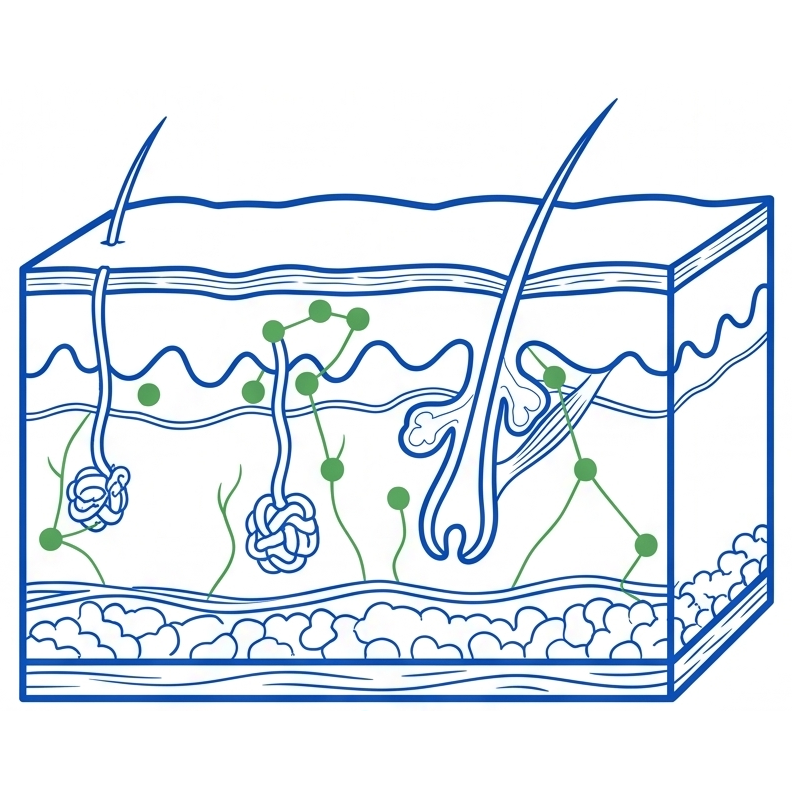
Generative artificial intelligence and foundation models applied to biology promise to drastically accelerate early-stage drug discovery. Yet, despite immense computational capacity and the proliferation of in silico platforms, the global clinical attrition rate in Phase II trials remains stuck near 70% with very few cases.
The root cause of this persistent gap is not algorithmic inadequacy; it is a fundamental computing principle: “Garbage In, Garbage Out” (GIGO). Training decision-making models on biologically biased, unstandardized, or physiologically incomplete datasets inevitably yields theoretical predictions that fail when exposed to human biology.
Algorithmic Blindspots: Dark Data and Experimental Noise
Deep learning models do not generate biological knowledge ex nihilo; they map statistical correlations within historical datasets (such as ChEMBL, PubChem, and scientific literature). This approach hits two structural limits:
- The Loss of Negative Data (“Dark Data”): The vast majority of published research documents only successful experiments. Inactive compounds, off-target toxicity, and early project failures are rarely digitized or shared. Deprived of negative data, AI models cannot learn the boundaries of biological efficacy. This breeds a confirmation bias, leading algorithms to propose compounds that appear chemically plausible on paper but remain biologically inert.
- Experimental Noise: Historical data often originates from heterogeneous, manual protocols across different labs. Unstandardized measurement noise is frequently misidentified by AI algorithms as meaningful biological signal.
The Trap of 2D “False Successes” and Selection Bias
The vast majority of legacy training data comes from flat, two-dimensional cell cultures on rigid plastic dishes.
Occasionally, a model trained exclusively on 2D data successfully predicts a viable drug candidate or repurposing target. However, these occurrences happen almost exclusively when the pathological mechanism or drug action is independent of 3D spatial organization or extracellular matrix dynamics—such as direct receptor-ligand binding or simple cytoplasmic enzyme inhibition.
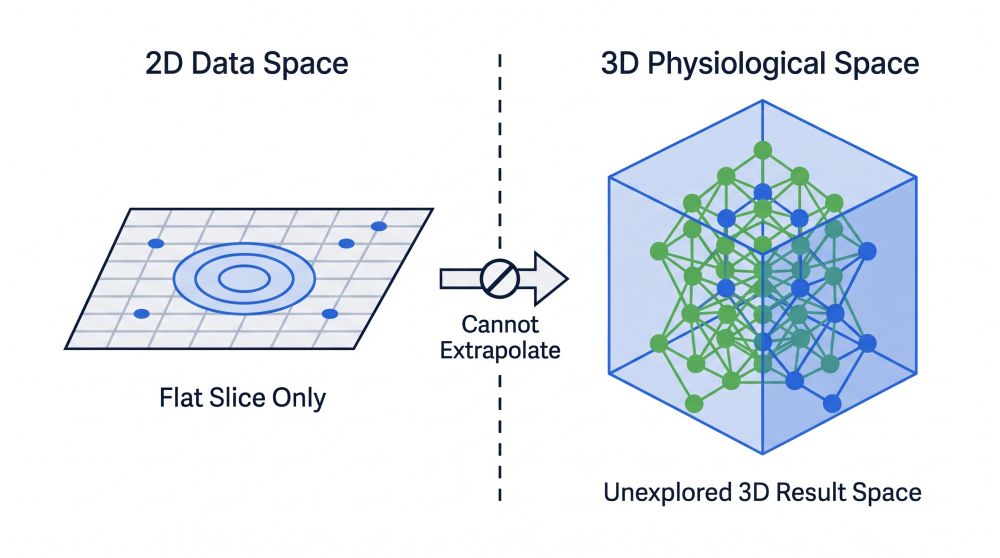
Celebrating these sporadic wins creates a dangerous selection bias. It fosters the misconception that 2D datasets are sufficient for predictive AI, whereas they fail systematically when applied to complex diseases (e.g., solid tumors, fibrosis, or chronic inflammatory conditions). In complex pathologies, 2D geometry alters gene expression, disrupts cell polarity, and distorts drug diffusion, leading algorithms directly to clinical failure.
Reconstructing Input Data: Organ-on-Chip & Organ-Specific Physioscaffolds
Overcoming the GIGO bottleneck requires replacing legacy datasets with biological ground truth engineered specifically for machine learning models. Creating human-relevant “AI-Ready” data relies on three core pillars:
- Microenvironmental Fidelity (3D, Physioscaffolds & Organ-on-Chip): Achieving predictive fidelity requires recapitulating the native human tissue environment. By combining Organ-on-Chip microfluidic technologies with organ-specific Physioscaffolds tailored to distinct tissue microenvironments, cell models retain native stiffness, mechanical constraints, fluid shear stress, and biochemical signaling. It’s exactly why our technology is a game changer in using AI assistance.
- Systematic Capture of Negative Data: An AI-Ready dataset must document inactive compounds and early toxicity with the same granularity as hits. Mapping failed candidates is mandatory to establish clear activity boundaries for machine learning classifiers.
- Automated Standardization: High-fidelity data production must rely on automated, robotic workflows. This removes operator variance, ensures strict reproducibility, and delivers structured datasets ready for algorithmic ingestion.
4. The Closed Feedback Loop: Rethinking Modern Drug Discovery
The future of drug discovery belongs to biotechs that seamlessly articulate computational intelligence with advanced wet-lab experimentation.
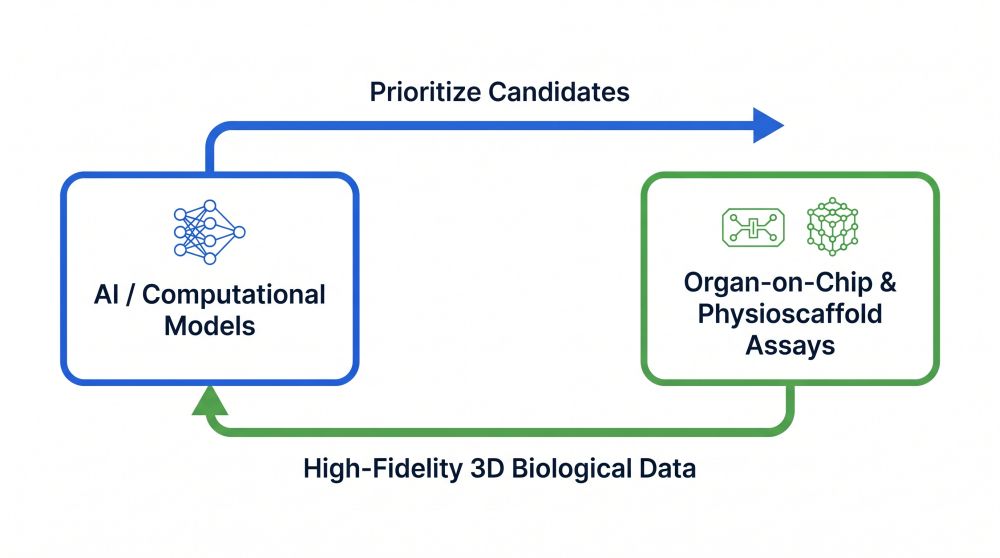
This integrated loop defines Organisyl’s strategic approach to modern biotech:
- In Silico Prioritization: AI serves as a high-speed decision filter to explore vast chemical spaces and generate prioritized candidates.
- In Vitro Biological Validation: Laboratory testing on organ-specific Physioscaffolds and Organ-on-Chip systems delivers definitive biological validation under real physiological conditions.
- Iterative Realignment: The quantitative output—both successes and failures—is fed directly back into the algorithmic model, refining its predictive accuracy for subsequent iterations.
Coupling laboratory-derived biological ground truth with AI computational power is not optional today. It is the essential architecture required to accurately predict compound activity, streamline hit-to-lead optimization, and maximize the efficiency of candidates entering clinical trials.
Our vision
An AI model’s predictive power is strictly capped by the fidelity of its training data. Solving drug discovery will not come from expanding neural network parameters alone, but from establishing high-throughput data foundries capable of producing human-relevant, 3D biological data. By uniting organ-specific physioscaffolds like Organisyl®, Organ-on-Chip platforms, and machine learning, modern biotechs can finally bridge the gap between computational prediction and clinical reality.