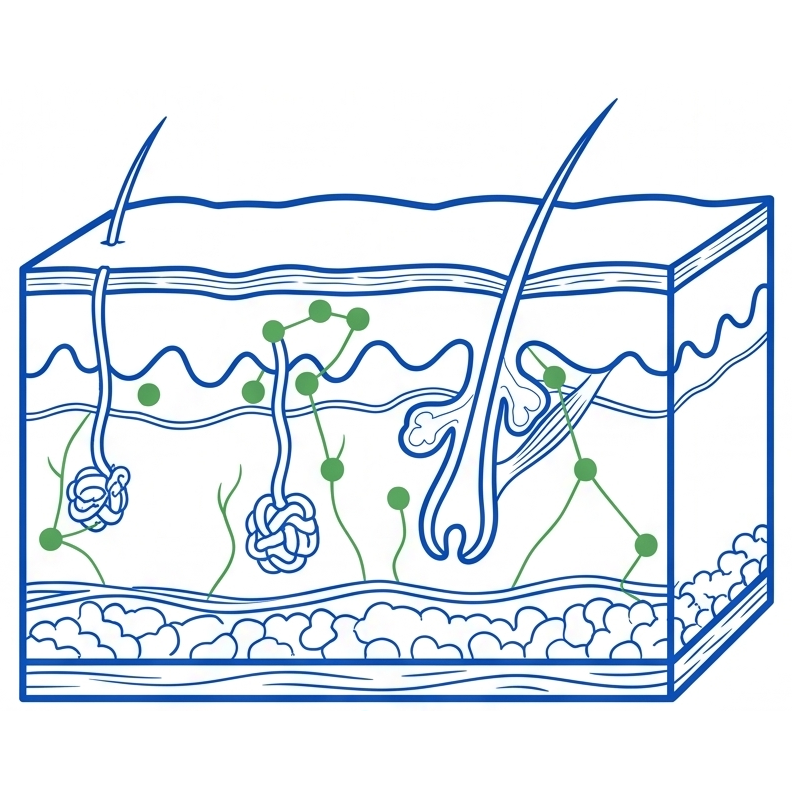
Artificial intelligence companies entering drug discovery possess unprecedented computational power, yet many face a fundamental blind spot: they lack wet-lab infrastructure capable of generating proprietary, high-fidelity biological data. As highlighted by the “Garbage In, Garbage Out” bottleneck, scraping heterogeneous public databases cannot yield reliable clinical predictions. Nor can this deficit be solved simply by acquiring or contracting conventional laboratories that rely on outdated, two-dimensional protocols. Building an exemplary dataset capable of transforming drug discovery requires a dedicated Biological Data Foundry, an industrial infrastructure engineered from the ground up to capture human physiology at scale.
Co-piloted automation: Uniting biologists and AI in the lab
Traditional preclinical testing suffers from manual execution, inter-operator variability, and fragmented reporting, resulting in noisy datasets that confound machine learning models. Overcoming this barrier requires an automated testing platform capable of evaluating compounds at scale under standardized three-dimensional conditions.
Rather than replacing human expertise, this automated environment operates under dual governance. Teams of experienced biologists define the therapeutic hypotheses, frame the biological endpoints, and validate strategic orientations. Working alongside them, an artificial intelligence engine continuously analyzes incoming results to prioritize which compounds should be tested next. Crucially, the algorithm does not merely interpolate existing findings; it proactively proposes novel compounds to probe unexplored regions of biological activity, systematically expanding the boundaries of what is known.
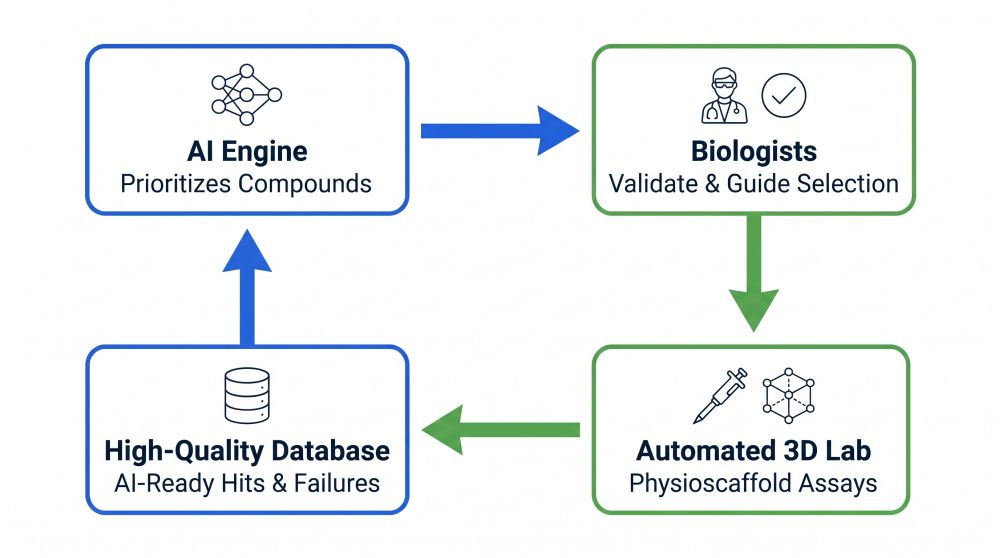
Every automated run captures quantitative outcomes with identical rigor, documenting both active hits and inactive or toxic failures. By elevating negative data to a first-class asset, the platform produces balanced, structured, and genuinely “AI-Ready” datasets.
The physical core: Organ-Specific physioscaffolds and Organ-on-Chip
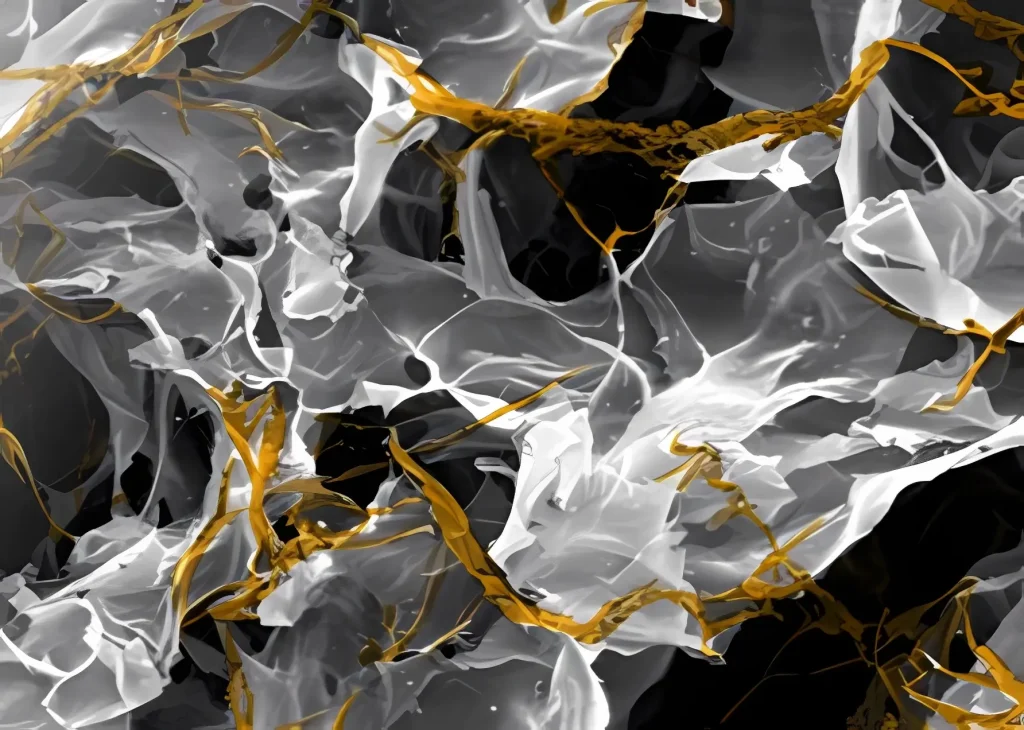
Automation alone is not a silver bullet. Automating assays on flat plastic surfaces or non-physiological synthetic substrates merely accelerates the production of biologically biased data. To generate training sets that translate to human patients, the physical test environment itself must mirror native tissue architecture.
Unlike purely virtual simulations or non-physiological supports, Organisyl’s Physioscaffold is a tangible physiological extracellular matrix engineered to replicate the mechanical stiffness, porosity, and biochemical signaling of living human tissues. By tailoring distinct Physioscaffolds to specific organs and disease microenvironments, and integrating them with Organ-on-Chip microfluidic technologies, the platform measures how drug candidates behave under realistic fluid shear stress, spatial gradients, and cell-matrix interactions. The resulting biological measurements reflect authentic human physiology rather than laboratory artifacts.
A combinatorial library built around human pathology
To turn physiological fidelity into an actionable predictive engine, data generation must follow a rigorous, multi-dimensional architecture. Organisyl structures its experimental output around a systematic combinatorial matrix crossing four foundational axes:
- Cell Types: Primary human cells and patient-derived populations capturing real biological diversity.
- Organ Microenvironments: Organ-specific Physioscaffolds tuned to healthy or fibrotic mechanical and biochemical states.
- Target Pathologies: Disease-relevant phenotypic models spanning oncology, inflammation, fibrosis, and tissue degeneration.
- Drug Candidates: Diverse chemical and biological libraries evaluated across standardized dose-response profiles.
Each experimental campaign feeds into a unified, living reference library. Because every assay is executed on standardized physiological matrices with harmonized readouts, compounds can be compared directly across tissues and disease states on a strictly consistent biological baseline.
Accelerating prioritization and preclinical de-risking
The operational impact of a combinatorial physiological library is a dramatic compression of discovery timelines. Instead of advancing compounds blindly through slow, sequential testing cascades, R&D teams can leverage AI-guided screening on organ-specific Physioscaffolds to evaluate broad candidate pools and prioritize the most promising molecules for a given pathology in a fraction of the current industry standard.
This approach delivers genuine preclinical de-risking. By identifying lack of efficacy or subtle tissue-specific toxicity early within a human-relevant 3D environment, organizations avoid committing hundreds of millions of dollars to clinical trials built on flawed premises. Capital and clinical resources are concentrated exclusively on candidates backed by robust physiological evidence.
Our Vision
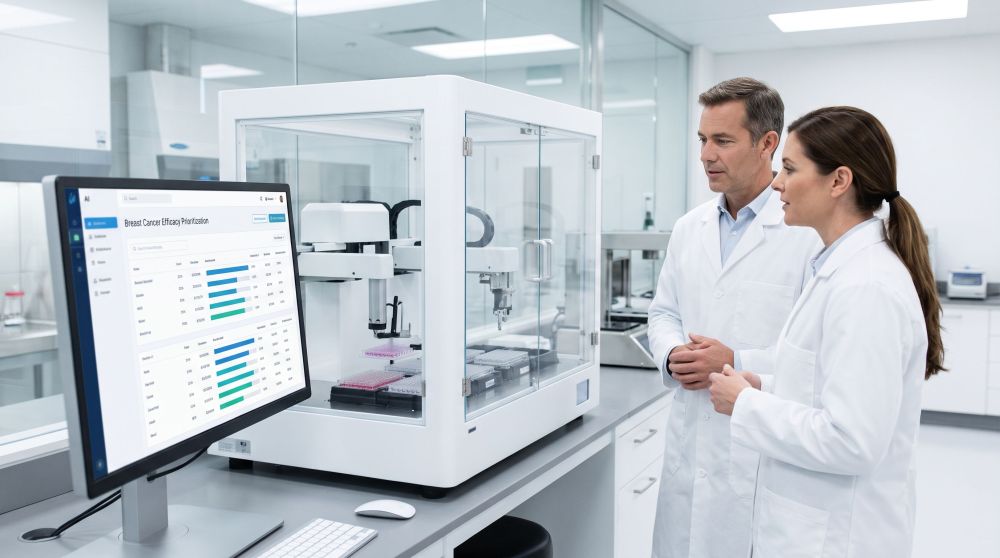
The predictive power of artificial intelligence in medicine will never exceed the physiological fidelity of the experimental data used to train it. Algorithms cannot extrapolate three-dimensional human biology from flat, unstandardized legacy assays.
As leading AI companies and computational research laboratories seek to anchor their foundation models in biological reality, the most decisive breakthroughs in drug discovery will emerge from strategic alliances with innovation-driven biotechs and pharmaceutical laboratories, those equipped with the experimental platforms required to test candidates in environments truly faithful to human physiology.
Some interesting sources
- Artificial intelligence in drug discovery: what is realistic, what are illusions? Part 2: a discussion of chemical and biological data
- Human organs-on-chips for disease modelling, drug development and personalized medicine
- Three-Dimensional in Vitro Cell Culture Models in Drug Discovery and Drug Repositioning
- Active-learning strategies in computer-assisted drug discovery